
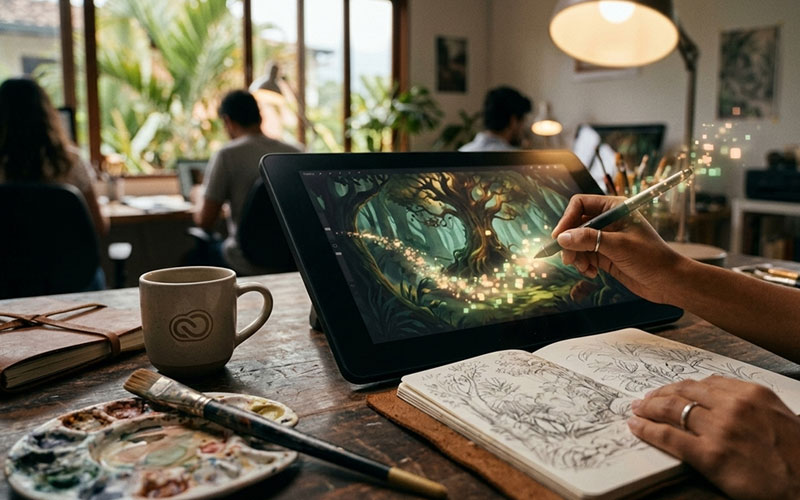
The Loom and the Weaver — In the late 18th century, the Luddites feared that the automated loom would destroy the craft of weaving forever. They saw the machine as the enemy of the artisan. History, however, told a different story. The machine didn’t kill weaving; it killed the drudgery of weaving, allowing the artisan to focus on more complex patterns, finer materials, and larger-scale visions.
Today, we stand at a similar crossroads. The «automated loom» of our era is Artificial Intelligence. To the casual observer, it looks like a replacement for the human hand. But to the true Digital Artisan, AI is the most sophisticated chisel ever invented.
In 2026, we are witnessing the birth of a new era. We are moving away from the «Software Operator» (someone who simply knows which buttons to click) and toward the «Creative Architect.» This is the story of how Adobe’s AI tools are not taking your job, but rather giving you your craft back.
The Death of the «Busywork» Era
For the last two decades, being a digital creative often felt like being a high-end data entry clerk. We spent 40% of our time masking hair, 20% of our time expanding backgrounds to fit different aspect ratios, and another 20% hunting for the perfect stock photo to «bash» into a composition.

This «Busywork Era» was the greatest thief of creative potential. When your brain is exhausted by the technical friction of a software’s interface, you have less energy for the actual Idea.
The Adobe Liberator
Adobe’s Generative AI—specifically tools like Generative Fill in Photoshop and Text to Vector in Illustrator—acts as a specialized assistant.
- The Manual Labor: Before, removing a complex object from a video required frame-by-frame rotoscoping.
- The Artisan Way: Now, with Content-Aware Fill for Video and Firefly-powered masking, that task takes seconds.
The Digital Artisan doesn’t celebrate the «speed» for the sake of profit alone; they celebrate it because it preserves their Creative Flow.
AI as a «Concept Multiplier,» Not a Replacement
One of the biggest misconceptions about AI is that it «does the thinking.» If you’ve ever tried to get a generic AI to produce a truly high-end, brand-specific campaign, you know this is false. AI produces the average of everything it has seen.
The Digital Artisan is the outlier.
Directing the Machine
The difference between a «prompt engineer» and an Adobe-powered Artisan is Intent.
An Artisan uses Generative Match to ensure the AI follows a specific lighting style they spent years perfecting. They use Structure Reference to ensure the composition follows the Golden Ratio or a specific sketches they hand-drew on an iPad.
In this workflow, the AI is not the creator; it is the Concept Multiplier. It allows you to see 50 variations of your specific idea in the time it used to take to sketch one. You aren’t choosing «what the AI gave you»; you are selecting the one path that matches your unique human taste.
The Return of «The Human Touch» (The Craftsmanship Gap)
As the world becomes flooded with «cheap» AI content, a strange thing is happening: Authentic, high-touch design is becoming more valuable.
When anyone can generate a «cool» image, «cool» becomes a commodity. What cannot be commoditized is Nuance.
- The Texture of Reality: An Artisan knows exactly how much grain to add to a photo to make it feel nostalgic rather than «low quality.»
- The Weight of Typography: An Artisan understands that the kerning in a headline can change the «voice» of a brand, something an automated layout tool often misses.
The Hybrid Workflow
The new Digital Artisan uses Adobe to handle the «Heavy Lifting» but finishes the work with the «Fine Brush.» They use Firefly to generate a base environment but then use Adobe Camera Raw and manual painting layers to give it a specific mood, color grade, and soul. This «Hybrid» approach is what separates professional work from the «AI-look» that is currently saturating social media.
Case Study: The 10x Creative
Let’s look at a practical example of the Digital Artisan in a modern agency setting.
The Task: Create an omni-channel campaign for a sustainable furniture brand, requiring 150 unique assets (social, print, web, OOH) for three different global markets.
The «Old» Way: A team of four designers works for three weeks. Most of the time is spent on «resizing» and «clipping.»
The Artisan Way: A single Lead Designer uses Adobe Express and GenStudio.
- They create a Master Brand Kit with custom Firefly models trained on the brand’s specific furniture.
- They use Bulk Create to generate the 150 variations, where the AI automatically adjusts the background to match the local culture of the market (e.g., a Tokyo apartment vs. a London flat).
- The Designer spends 90% of their time on the Creative Strategy—the «hook,» the copy, and the emotional resonance—and only 10% on the execution.
The result is better work, produced faster, by a human who is empowered, not exhausted.
How to Future-Proof Your Craft
If you are a creative today, your goal should not be to «beat» the AI, but to Curate it. Here are the three skills the Digital Artisan must master to stay indispensable:
- Mastering «Intentionality»
Stop asking the software «What can you do?» and start telling it «This is what I want.» Use tools like Parametric Filters and Precision Selections to maintain total control over the output.
- Developing «The Eye»
As execution becomes easier, Taste becomes the ultimate currency. Spend more time studying art history, color theory, and psychology. The software can generate a million colors, but only a human knows which one feels right for a funeral vs. a wedding.
- Embracing «Iterative Thinking»
In the past, we were afraid to «try something different» because it took too long to redo. The Digital Artisan thrives on iteration. Use Version History in Creative Cloud to explore radical branches of an idea. The more you experiment, the more «Artisanal» the final product becomes.
The Renaissance of the Individual
We are not entering the «End of Design.» We are entering the Renaissance of the Individual. For the first time in history, the gap between «having an idea» and «seeing that idea realized» has almost vanished. This doesn’t make the designer less important—it makes them a Super-Creative.
Adobe’s mission isn’t to build a «Creative Robot.» It is to build a «Creative Exoskeleton» for the human mind. The Digital Artisan is someone who wears that exoskeleton to reach heights that were previously impossible.
The machine is ready. The tools are refined. The only question left is: What will you choose to build with them?
Step Into Your New Role
The transition from operator to artisan starts with a single click. Don’t fear the future—shape it.
[Experience the Future of Craftsmanship with Adobe Creative Cloud] See how Firefly-powered workflows can give you back your most valuable asset: your time to dream.