
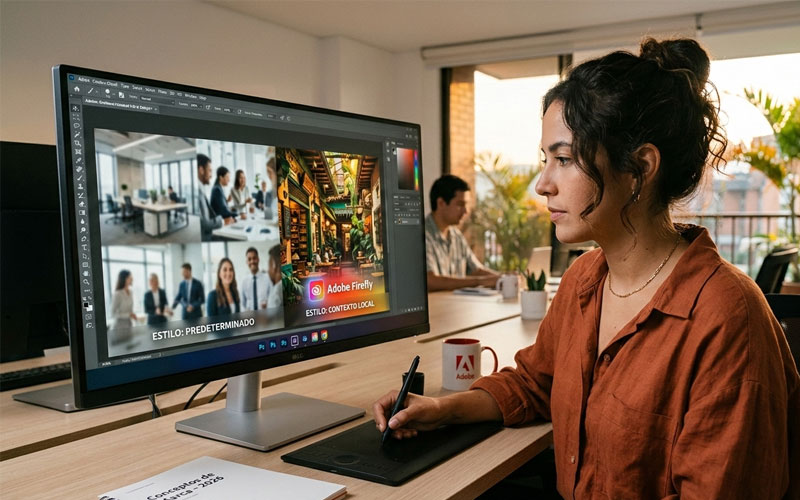
The Fatigue of “Empty Hyper-Realism”
In the early 2020s, the rise of generative AI promised an unprecedented visual democratization. But by 2026, we’ve hit an unexpected side effect: the “Global Visual Soup.”
Millions of images, created using the same prompts and models, have flooded the market with visuals that are technically flawless — yet emotionally sterile.
Today’s audience has developed a sixth sense for spotting generic synthetic content. When everyone can generate “a modern office with sunset lighting,” that image loses its value.
This is where the paradigm shifts: it’s no longer about who has the fastest AI — it’s about who knows how to use tools like Adobe’s ecosystem to inject identity, culture, and local context into every pixel.

The Problem: The Uncanny Valley of Global Marketing
For years, major brands relied on a “one-size-fits-all” approach. A campaign designed in New York would be translated and launched in Mexico City, Madrid, or Tokyo with minimal adjustments.
Early generative AI only amplified this issue, producing a “transnational” aesthetic that belongs nowhere.
Cultural Disconnect
Generic design ignores nuance. A color that signals prosperity in one culture may represent mourning in another. The quality of light hitting a building in Berlin differs from the way it falls in Bogotá. Vegetation, shadows, architectural rhythm — they all matter.
Adobe recognized that the future isn’t mass generation. It’s intelligent re-stylization.
Adobe Firefly and the Concept of “Local Flavor”
The real power of Adobe Firefly in 2026 isn’t just creating images from scratch. It’s style and structure transfer.
Geographic Re-Stylization
Imagine you have a base campaign for a premium coffee brand.
With Generative Match tools inside Adobe Photoshop or Adobe Illustrator, you can reference a real neighborhood where you plan to sell — and guide the AI to adopt that color palette, architectural feel, and lighting atmosphere.
Use Case: A fashion brand can transform its summer catalog so the shadows and background vegetation align precisely with the local flora of the region where the dynamic ad is being displayed.
That’s not just efficiency. That’s respect for consumer identity.
Micro-Personalization: From Segments to Individuals
Adobe GenStudio has become the command center of this creative shift.
We’re no longer targeting “men aged 25–40.”
Now, thanks to integrated data and creative workflows, brands can speak directly to:
“A 30-year-old freelance designer living in a bohemian neighborhood in Barcelona who prefers 1970s minimalist aesthetics.”
The Workflow of the Future
Master Asset: Create a core piece in Illustrator or Photoshop.
Contextual Variation: Using Adobe Express and Firefly, generate variations that preserve logo structure and product integrity — while adapting the surrounding environment for micro-niches.
Brand Consistency: Unlike many AI tools that over-invent, Adobe allows you to lock brand elements — exact corporate colors and logos — using Custom Models trained exclusively on your brand assets.
The Ethics of Authenticity: The Role of Content Credentials
Transparency is becoming a competitive advantage.
In 2026, consumers value knowing what is real and what is AI-assisted.
Content Credentials — often described as “nutrition labels for digital content” — allow brands to disclose how an image was created and confirm ethical training data sources.
That level of clarity separates professional brands from those relying on questionable free tools.
The Business Case: Why Local Personalization Is Survival — Not Luxury
By 2026, the data is clear: consumers ignore what doesn’t feel familiar.
Recent advertising impact studies show that campaigns using locally contextualized visual elements generate 42% higher click-through rates (CTR) than generic global campaigns.
The ROI of Re-Stylization with Adobe
Traditionally, adapting one global campaign to 10 local markets required:
- 10 photoshoots
- 10 post-production teams
- Weeks of coordination
With Firefly and GenStudio, the economics shift dramatically.
Production Cost Reduction: Using Generative Fill and Generative Match, a brand can place its product on a beach in Thailand, a café in Paris, or a market in Mexico City — all starting from a single high-quality product photo.
Logistics and travel savings can reach up to 70%.
Speed to Market: What once required 20 days of manual retouching can now be achieved in 20 minutes of AI-assisted iteration.
That means reacting to local viral trends in real time — something that was nearly impossible with 2020-era workflows.
Infinite Scalability: One skilled professional, supported by automation inside Adobe Express and Creative Cloud Libraries, can manage asset output for hundreds of micro-segments — without compromising brand consistency.
From “Prompting” to Art Direction: The Creative’s New Role
Many feared AI would replace designers.
The reality in 2026 shows the opposite: AI has replaced the software operator — but elevated the Art Director.
Generic design is born from algorithmic laziness.
High-impact design is born from human curation.
Adobe’s tools are not built for AI to decide for you. They’re built to give creatives intelligent brushes that obey cultural vision.
“The tool knows how to render a tree. Only the designer knows which tree evokes childhood memories for their audience in southern Italy.”
Practical Implementation: How to De-Genericize Your Brand
If your company wants to make the shift, it’s not about installing a new app. It’s about changing your production mindset.
Train Custom Models: Use Firefly Custom Models trained exclusively on your brand archive. This ensures AI never generates something that “doesn’t look like you.”
Context Audit: Before launching, use Adobe’s sentiment and color analysis tools to confirm that generated palettes resonate with local values.
Total Transparency: Implement Content Credentials. In a market saturated with deepfakes, transparency around “how this was made” becomes a brand trust asset.
Conclusion: The Future Is Hyper-Local — and Human
“Generic Design” was a transitional phase — a technological growing pain.
In 2026, the true competitive advantage isn’t access to AI — everyone has it.
The advantage lies in how you use tools like Adobe’s ecosystem to inject soul, context, and local truth into every communication asset.
Brands that continue sending plastic, interchangeable messages will become invisible.
Brands that use technology to move closer to everyday human reality will lead the decade.
Ready to Move Beyond Generic?
The difference between an ignored image and a converting campaign often comes down to the tools you use.
Don’t let your brand get lost in the visual noise of basic AI.
Explore the latest capabilities inside Adobe Firefly and Adobe GenStudio and discover how generative AI — designed specifically for professionals — can elevate your workflow to levels of personalization that were previously impossible.
Start your free trial and experience precision-driven creative production firsthand.